


The Hans Hedtoft Disaster

Updated: Sep 6, 2025
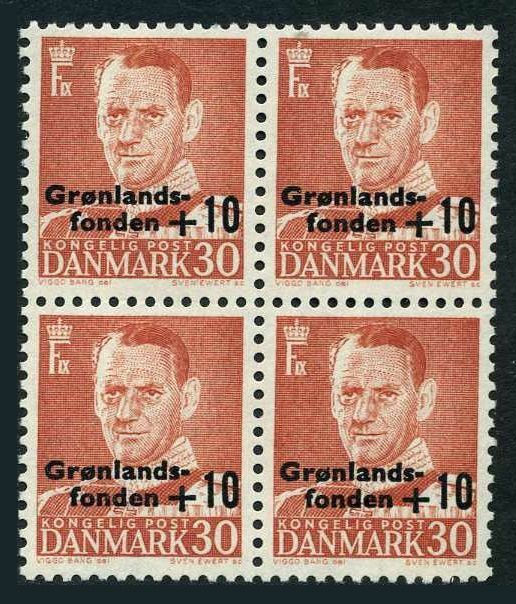
Earlier this year a stamp dealer called Robert Laidler, who sent me approvals, told me about these stamps issued by Greenland and Denmark in 1959.
In 1959 surcharges were printed on the existing 30 Øre definitives, which featured a portrait of King Frederik IX, to raise funds for the Greenland Fund. In addition to the standard postage, 10 Øre from the sale of each stamp was donated to the Fund...but what exactly was it? And why were these charity stamps so important?
If I was to ask you which ship sank on its maiden voyage after hitting an iceberg, you would almost certainly say "The Titanic"! But it was, sadly, not the only ship to suffer such a fate. On 30th January 1959, while returning back to Greenland from Copenhagen, the Hans Hedtoft collided with an iceberg near Uummannarsuaq. Despite issuing distress signals no help arrived and the ship sank with the loss of all 95 people on board. All that was discovered from the wreckage was a single lifebelt a few months later.
Prior to the Hans Hedtoft's maiden voyage, there were many opposed to the principle of passenger sailings during the winter as they feared it may be too dangerous. Among the critics was Augo Lynge, a Greenland MP who sadly died in the disaster.

Hans Hedtoft was named after a former Prime Minister of Denmark. She was designed to provide a new all year round service between Greenland and Denmark and was supposed to symbolise new hope and a greater sense of connectedness between Greenland and Denmark. Instead, the tragedy left many Greenlanders feeling more isolated. The sinking had a huge impact in Greenland and Denmark. There was a feeling of national shock and disbelief. The Hans Hedtoft had been specifically built for the route and designed with severe winters and harsh conditions in mind. Many people were angry and there were arguments that the disaster could have been avoided if the ship had been fitted with a welded hull instead of a riveted hull. Some criticised the lack of response to distress signals; two ships, the West German Johannes Krüss and the US coastguard ship Campbell, were not too far away but failed to arrive in time. Conditions were reported by the crew of Campbell to be exceptionally bad. Johannes Krüss arrived on the scene only a few minutes after Hans Hedtoft disappeared beneath the waves. While no-one questioned the bravery of the crews on Campbell and Johannes Krüss, many questions were asked about the lack of rescue ships in the area, the lack of radio beacons, whether the ship had been adequately equipped and whether the authorities had been negligent.
Denmark prided itself on its maritime competence, so losing a brand-new, state-of-the-art ship was seen as both humiliating and tragic. The sinking was called "the Danish Titanic". Flags were flown at half-mast, newspapers gave it front-page coverage for weeks and a memorial service was held at Holmens Church in Copenhagen, attended by the Danish royal family. It was, after all, one of the worst peacetime maritime disasters in Danish history.

The stamps went on sale on 23rd February 1959. Denmark sold a total of 1,860,000 of them, while Greenland sold 345,000, raising well over Kr 2million for the Greenland Fund. Other sources of fundraising resulted in the Fund's total income of Kr 3.7million in its first year. Curiously, compensation for the victims' families amounted to only Kr 1,184,936 with only around half of the families receiving any payment at all - which raises obvious questions about what happened to the rest of the money raised. (The Fund continued to operate until 2005, promoting cultural ties between Greenland and Denmark.)
The disaster is remembered in both Greenland and Denmark in perhaps the same way Titanic is in the UK. In the church in Qaqortoq there is a memorial plaque with the names of the deceased and the recovered lifebuoy. Memorial plaques can also be found in Nanortalik and at Nordatlantens Brygge in Copenhapen. In 2019 the 60th anniversary of the sinking was marked in Greenland with the usual local observances but also the release of Hedtoft - a short film, told from the perspective of a grandson of one of the victims. The film won several international awards. As the last ever civilian ship to sink after striking an iceberg, Hans Hedtoft should perhaps be better known across the world. Fortunately these stamps continue to remind us of that terrible afternoon in January 1959. Many thanks to Robert Laidler (sadly no longer with us) for encouraging me to write about this and for everyone who has helped me to do the research and editing.


Comments