


New Issue: General Tadeusz Rozwadowski (Poland)

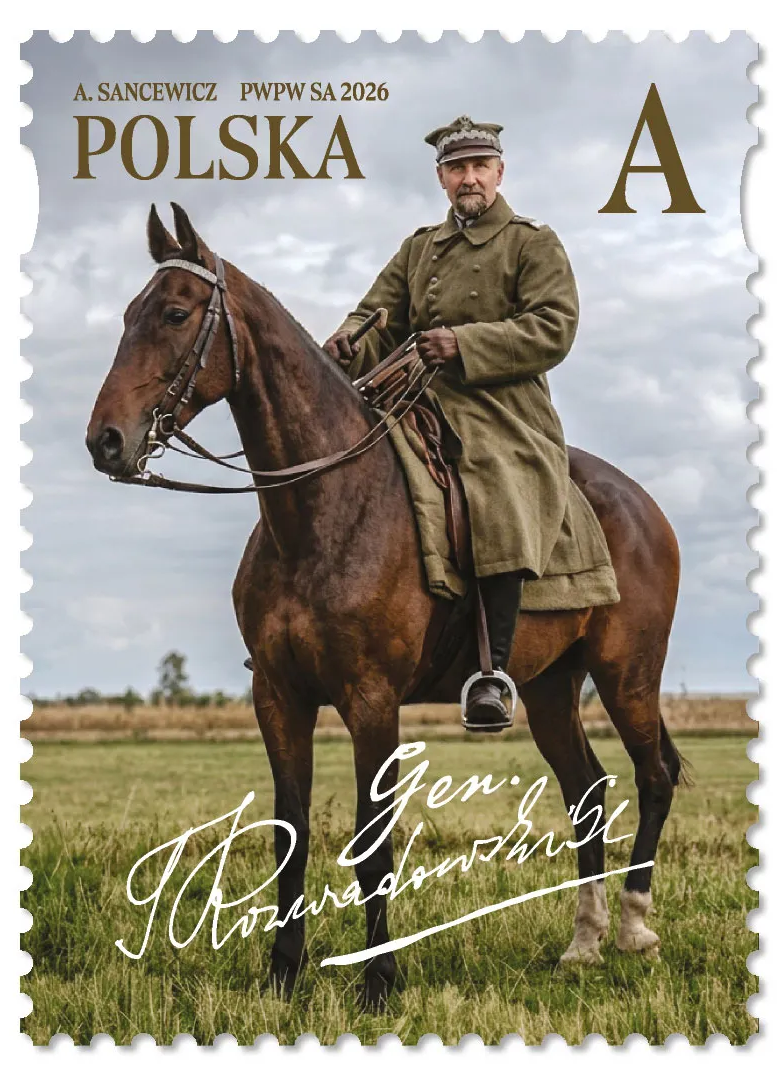
This is another excellent issue from Poland. It was released on 15th August, which is Polish Armed Forces Day.
You may not have heard of General Tadeusz Rozwadowski. To be honest, neither had I, which is one reason why creating stamps in memory of people is a good thing. The stamp made me want to find out more about his life and his achievements. Poczta Polska's website very helpfully gives more information about General Rozwadowski: "[General Rozwadowski] was one of the most distinguished Polish military commanders and organizers of the Polish Armed Forces. The issue honors a figure whose contribution to rebuilding the Polish Army after independence and to the victory in the Battle of Warsaw in 1920 remains one of the most important achievements in modern Polish military history. The issue was prepared in cooperation with the Ministry of National Defence.
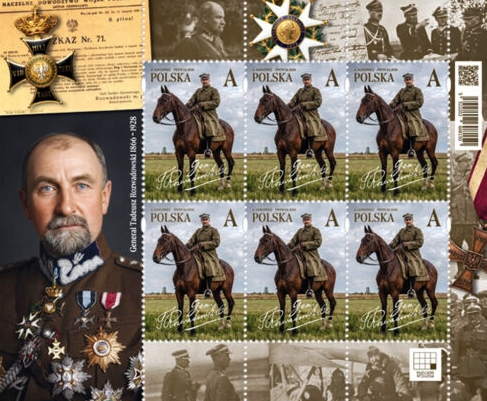
"The stamp features an archival photograph of General Tadeusz Rozwadowski from the collections of the Polish Military Historical Bureau (Wojskowe Biuro Historyczne). The image of the general on horseback emphasizes his military service, leadership role and contribution to rebuilding the Polish Army after 1918. The sheet consists of 6 stamps arranged in a 3 × 2 layout. The surrounding artwork creates a broader historical narrative devoted to the General’s life and military career.
"Tadeusz Jordan Rozwadowski (1866–1928) was one of the most prominent Polish military leaders of the late 19th and early 20th centuries. He began his military career in the Austro-Hungarian Army, where he gained valuable command and staff experience. After Poland regained independence, he became one of the leading organizers of the Polish Armed Forces and served as: Chief of the Polish General Staff, commander during the Polish-Soviet War, one of the architects of the modern Polish Army. A key chapter of his career was the Battle of Warsaw of 1920. The operational plan was developed through the efforts of several important figures, including: Józef Piłsudski, General Tadeusz Rozwadowski, General Władysław Sikorski, General Maxime Weygand, the operational staff of the Polish Army. Rozwadowski was responsible for preparing and coordinating the plan from the staff perspective, which contributed significantly to the victory over the Red Army. Following the May Coup of 1926, he supported the constitutional authorities [against Piłsudski]. After the conflict, he was arrested and removed from public life, effectively ending his military career. Today, his contribution to the development of the Polish Army and the victory in 1920 is being increasingly recognized."
What Poczta Polska doesn't tell you is how General Rozwadowski's colleague, General Włodzimierz Zagórski, mysteriously disappeared in 1927. They had planned air raids together during the 1926 May Coup. We're also not told of the strange circumstances of General Rozwadowski's death in 1928. There were allegations that he had been poisoned. It all looks very suspicious and rather than just "ending his military career" it is possible that loyalty to the "constitutional authorities" - the legal coalition government - effectively ended his life. What we do know is that the Polish media of the time, and later Communist authorities, made false allegations about him and went to great lengths to erase his memory.
It is only in recent years that his role in the Battle of Warsaw and his wider contribution have been re-examined. In 2019, he was named the patron of the 23rd Artillery Regiment. So this stamp helps to give him the recognition that he deserves.
The stamp has been designed by Agnieszka Sancewicz, an award-winning stamp designer. The photo colourization was by Mirosław Szponar.
A miniature sheet has also been produced. This includes six of the stamps and additional archive photographs.
Design Quality: At first this looks like quite a traditional stamp showing an important military figure, but I think there are a couple of things that make the design much better. The biggest one is the decision to colourise the old photograph of General Tadeusz Rozwadowski on horseback. Instead of looking like a distant figure in an old black-and-white photograph, he suddenly seems much more like a real person. You can imagine him and his horse actually standing in that field. I think that is especially important on a stamp which is trying to bring attention back to somebody who was forgotten for far too long. I also really like the inclusion of his signature across the bottom. It adds a personal touch and makes the design feel as though it is about him, rather than just being another picture of a general. 8/10
Theme and Subject Choice: This is an excellent choice of subject, especially because the stamp was issued to coincide with Polish Armed Forces Day on 15 August. General Rozwadowski was one of the most important Polish military commanders of his time and played an enormous role in the Polish victory at the Battle of Warsaw in 1920, so remembering him on this particular day makes complete sense. I think it is also good that the stamp doesn't just choose the most obvious famous name from Polish military history. Instead, it gives some attention to somebody whose achievements weren't properly recognised for many years. That makes this much more than just another stamp showing a general. 9/10
Historical and Cultural Relevance: This is where I think the stamp becomes really important. General Rozwadowski played a major role in Polish history, including as Chief of the General Staff during the Battle of Warsaw in 1920. However, after he opposed Piłsudski during the May Coup of 1926, he was imprisoned, and his reputation and achievements were later pushed out of public memory. Censorship under the Sanacja authorities contributed to this, and after the Second World War Communist censorship continued it. For decades, people were therefore not given a fair picture of what General Rozwadowski had actually contributed to Poland.
That means this stamp is doing something quite powerful. It isn't simply remembering history – it is helping to correct the way history is remembered. By putting Rozwadowski on a Polish stamp, people might see his name, wonder who he was and discover the enormous contribution he made. He might have been deliberately pushed out of the story for many years, but this stamp helps to put him back into it. 10/10
Innovation and Creativity: The basic idea of putting an important historical person on a stamp obviously isn't very innovative, and neither is using an old photograph. What makes this more creative is the colourisation. It completely changes how I react to the photograph. Rather than simply reproducing an old historical image, the designer has made it feel much more immediate and alive. The colours are quite natural and restrained too, which is important because really bright colourisation could easily have made the photograph look fake. Together with the signature, it feels like an attempt to introduce Rozwadowski to a modern audience rather than just show us an old photograph of him. 6/10
Collectability: There are obviously a lot of military stamps out there. What makes this one different? I think this should be quite collectable to different kinds of collectors. It should obviously interest people who collect Polish stamps, but military history is also a huge subject for collectors and Rozwadowski's connection with the Battle of Warsaw gives the stamp even more historical interest. People who collect stamps featuring horses might even find something here! More importantly, there is a really good story behind the issue. Once you understand why remembering General Rozwadowski matters, the stamp becomes much more interesting than a simple portrait of a general. I think stamps with a story behind them are often the ones that are most interesting to keep. Will everyone understand the importance of the stamp? I don't know and I think that's a problem - to many people this may look like just another stamp with military connections. 7/10
Personal Appeal: What this stamp is doing is so important. Remembering Polish Armed Forces Day is important in itself, but this stamp goes further by remembering somebody who, for far too many years, was deliberately pushed out of history. General Rozwadowski wasn't simply somebody people happened to forget as time passed. His achievements were played down and his memory suffered because of politics, and later Communist censorship helped keep him forgotten.
That makes seeing him proudly displayed on a Polish stamp feel much more significant. A stamp obviously can't undo what happened to him, but it can help make sure that people today know his name and understand what he did. Somebody might receive a letter with this stamp, wonder who the man on the horse is, and end up discovering a part of Polish history they didn't know about. I know that I have. I think there is something really powerful about using a stamp to help right an old wrong. 10/10
Overall Score: 50/60
EDITOR'S NOTE: Xanthe required some assistance and guidance with this piece, which has taken a couple of days' work. She generally likes to research subjects she doesn't know about and her online searches threw up a lot of information about the Battle of Warsaw, the May Coup and Polish politics of the 1920s that she struggled to fully understand. She did grasp that a serious injustice had been done to General Rozwadowski's memory and felt that the Poczta Polska summary didn't go far enough in describing this. Xanthe was determined to play a small part in helping to restore General Rozwadowski to his rightful place in history. With some help in untangling the complicated politics surrounding his treatment and ensuring that her conclusions were supported by the historical evidence, the opinions expressed here are very much her own. She was especially struck by the idea that a postage stamp can help correct the historical record and give recognition back to someone who was deliberately denied it for so long. The historical point behind her reaction is well supported: Poland's Institute of National Remembrance confirms that Rozwadowski's memory was intentionally suppressed, firstly by Sanacja censorship and subsequently Communist censorship, with recognition of him only gradually returning from the late 1980s. It also credits him with preparing plans for the Battle of Warsaw.


Comments