


New Issue: The 100th anniversary of the birth of Professor Krzysztof Skubiszewski (Poland)


I don't know about you, but I have been impressed with some of the new Polish issues this year, especially those for WOŚP and General Tadeusz Rozwadowski. These have been two of the highest-scoring issues in my reviews, and I think the Rozwadowski stamp shows that Poczta Polska (Polish Post) understands how to respect the past meaningfully.
A new stamp from Poczta Polska, issued on 8th October, marks the 100th anniversary of the birth of Professor Krzysztof Skubiszewski. I would imagine that most people in the UK would not know who Prof Skubiszewski was, so I will try to describe his life in a few paragraphs.
The life of Krzysztof Skubiszewski
Krzysztof Skubiszewski (1926–2010) is mostly remembered as a Polish diplomat and politician who served as the Minister of Foreign Affairs of Poland from 1989 to 1993. He played a crucial role in transitioning Poland from a communist state to a democratic one and integrating it into Western institutions like NATO and the European Union.
Before his life in politics, Prof Skubiszewski taught international law at Poznan University. His specialism was Polish-German relations and he was later a member of the Hague Academy of International Law. However, he was more than just an academic. Prof Skubiszewski was an ad hoc judge at the International Court of Justice and, during the rule of General Wojciech Jaruzelski, became a supporter of the Solidarność movement.
Solidarność (Solidarity) was the first independent, self-governing trade union in the Soviet bloc, founded in Poland in August 1980. It began on August 14, 1980, when workers at the Lenin Shipyard in Gdańsk, led by electrician Lech Wałęsa, went on strike to demand better working conditions, the right to form independent unions and political freedoms. It grew into a massive, non-violent social and civic movement that eventually ended communist rule in Poland and inspired action in other Eastern Bloc countries.

A postcard from Gdansk, signed by Lech Wałęsa of Solidarność. It reads:
"Dear Sir, Thank you very much for remembering me and for your expressions of solidarity.
With kind regards, Lech Wałęsa. Gdańsk, 29 June 1983."
This is in my dad's collection of political documents and photographs.
The Round Table Talks led to Poland holding its first free elections in over 40 years, on 4th June 1989. Solidarność won almost all of the freely-contested seats, marking the end of Communist rule. New Prime Minister Tadeusz Mazowiecki appointed Prof Skubiszewski foreign minister. This was a very important decision as Lech Wałęsa noted in his book, The Struggle and the Triumph (Polish: Droga do prawdy): "Five days after my return to Poland, Prime Minister Mazowiecki announced the composition of this government... a professor from Poznan, Krzysztof Skubiszewski, was named to the post of foreign minister. Up to then, Skubiszewski had been little known, but he was to prove very helpful because of his connections."
"Very helpful" is something of an understatement. As the first foreign minister of the Third Republic he served four four years under Prime Ministers Mazowiecki and Jan Olszewski, Skubiszewski oversaw Poland’s reintegration into Europe. He managed the negotiations that resulted in Soviet forces leaving Poland. He negotiated Poland’s withdrawal from the Warsaw Pact and its accession to the Council of Europe. Skubiszewski was a believer that Poland should "return to Europe" and laid the groundwork for NATO (1999) and EU membership (2004). He also helped create the Council of the Baltic Sea States.
As Polish diplomat (and, later, also Foreign Minister) Adam Rotfeld stated, "he managed to arrange relations with all neighbours in such a way as not to provoke conflicts." That was a major achievement at a time of uncertainty. It's easy to forget, but in August 1989 the leaders of Romania and East Germany called for a "Warsaw Pact intervention in 'rebellious' Poland" to halt moves towards democracy. Both were out of power by the end of the year.

Lech Wałęsa on an official visit to London as President of Poland in April 1991. Pictured behind him are Janusz Świtkowski (Head of Polish diplomatic protocol) and Krzysztof Skubiszewski (Foreign Minister).
Prof Skubiszewski proved to be an incredibly successful Foreign Minister. His achievements include signing the 1990 German–Polish Border Treaty, which secured Poland’s western border. Unlike many in Europe at the time, Skubiszewski did not fear a united Germany but saw it as a useful ally and partner. This led to him negotiating the 1991 Treaty on Good Neighbourship with Germany (and later, in 1992, with Russia and Ukraine) which provided a foundation for reconciliation and cooperation. He also co-founded the Weimar Triangle with the German and French foreign ministers in 1991.
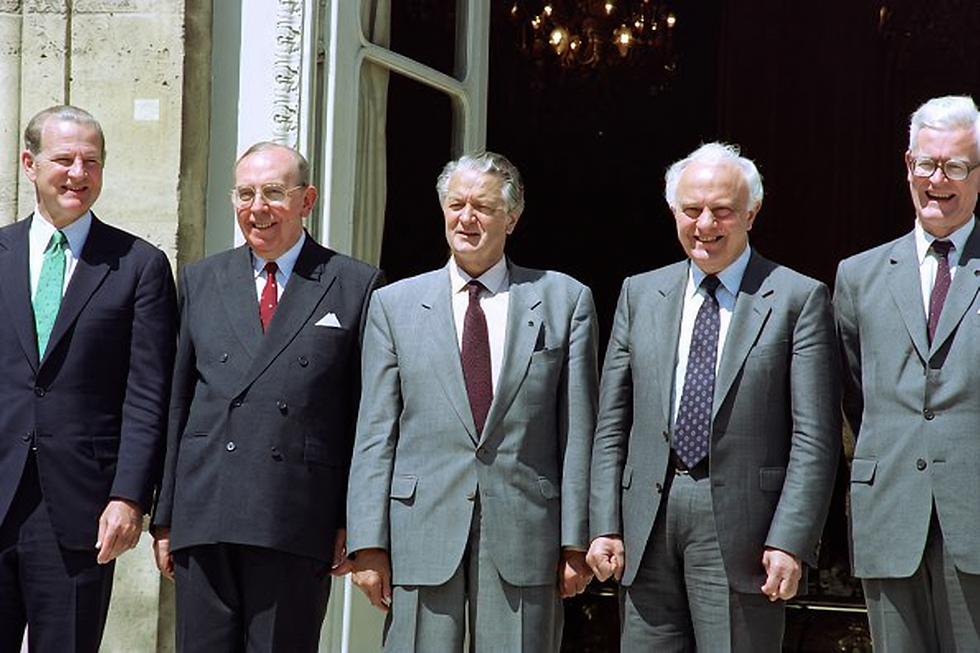
Krzysztof Skubiszewski (second left) pictured with US Secretary of State James Baker, French foreign minister Roland Dumas, Soviet Union foreign minister Eduard Shevardnadze and British foreign secretary Douglas Hurd during the "Two-plus-Four" talks.
Skubiszewski was instrumental in establishing institutional ties with Western Europe and developed a good relationship with British foreign secretary Douglas Hurd. Skubiszewski and Hurd worked together during the "Two-plus-Four talks" talks on the western border and German reunification. Good relationships with other Western leaders helped Poland’s entry to the Council of Europe in 1991.
After politics, Prof Skubiszewzki specialized in international law and human rights. He was always active in public life and was awarded the Order of White Eagle, Poland’s highest civilian honour.
While Prof Skubiszewski is rightly remembered in Poland as a father of liberty and an influential statesman who helped shape modern Poland, he was also an internationally respected human rights lawyer and an admired university professor. This stamp remembers him as a man who was all of these things - a statesman, a lawyer and an academic. How the stamp came about
Stamps don't just create themselves - they are often the result of years of campaigning. The idea for a stamps celebrating the centenary of Prof Skubiszewski's birth was born twelve years ago, when Łukasz Dembski - a philatelist who holds a PhD in Political Science - approached Poczta Polska with a proposal. "The idea of issuing a stamp to mark the centenary of Professor Skubiszewski's birth first came to me in 2014" Mr Dembski told Xanthe's Stamp Magazine. ""My aim was to ensure that his achievements would be remembered by a wider audience. I worked on the project for last two years. Mr Jacek Tomczak - the member of parliament I work for - also became involved in the effort. The support of the Polish Ministry of Foreign Affairs (Minister Radosław Sikorski and State Secretary Marcin Bosacki) was also very important. However, we remained committed to achieving our goal. After two years of work, we ultimately succeeded in bringing the project to a successful conclusion.
"Let me add, a special role was also played by the family of Minister Krzysztof Skubiszewski, particularly his brother Piotr, his nephew Marcin, and Marcin’s wife, Marie-Hélène. The photograph used in the design of the stamp was taken by Professor Piotr Skubiszewski himself.
"The campaign was a tremendous undertaking. I involved around forty people, including the Minister of Foreign Affairs, deputy ministers, a member of parliament, a former prime minister and several diplomats. It required numerous conversations, considerable lobbying and a great deal of perseverance. This was not simply a philatelic initiative; it was also an attempt to convince different people and institutions that a man who had played such an important role in modern Polish history deserved to be commemorated.
"Why was this stamp so important to me personally? Krzysztof Skubiszewski was a great Polish statesman and, at the same time, the central figure of my doctoral research. As Poland's first Minister of Foreign Affairs following the fall of communism, he played a crucial role in defining our country's place in Europe and the wider world. His contribution to Polish diplomacy and national security cannot be overstated. I believe he served his country exceptionally well and deserves a permanent place in our collective memory."
This is not the only occasion that Łukasz Dembski has been involved in helping Poczta Polska create special stamps. In 2014 he "managed to secure the issue of a commemorative postcard and a special postmark to mark the opening of the Krzysztof Skubiszewski Memorial Chamber". In 2015, Mr Dembski successfully campaigned for a stamp in memory of Professor Władysław Bartoszewski, another former Polish Minister of Foreign Affairs and a heroic freedom fighter who took part in the Warsaw Uprising. He was later named as being a member of the Righteous among the Nations - an honour bestowed on non-Jews who saved Jews from extermination during World War II. Bartoszewski, a former Auschwitz prisoner, was later a member of Solidarność and was imprisoned during the era of martial law. He was clearly always a fighter. In 1989 he achieved his vision of a free Poland, but he didn't stop writing about the risks of totalitarianism and taught history at several universities. You would think he would be an obvious person to commemorate on a stamp but, without Mr Dembski's campaigning, this fantastic stamp would never have been released.

Dembski has also advised to secure other stamp issues, including Polish-German youth cooperation (2016), the 1,050th anniversary of the Diocese of Poznań (2018), the work of the Never Again Association and its opposition to concentration camps (2018), the centenary of the Union of Poles in Germany (2022), the 25th anniversary of Poland's membership of NATO (2024) and the 20th anniversary of Poland's membership of the European Union (2024). As he acknowledges, ‘Despite the efforts made, it was not possible to bring to fruition the initiatives to issue a stamp commemorating the centenary of the Poznań International Fair in 2021 or one marking the 100th anniversary of Professor Jerzy Łukaszewski’s [a Polish émigré, professor and long-serving rector of the College of Europe in Bruges] birth in 2024.’
Was it worth the two years of hard work and campaigning? Łukasz Dembski definitely thinks so. "Without the slightest doubt — yes!" he told us. "It was an undertaking that required considerable commitment and perseverance, but it ultimately proved successful and brought me immense joy. The cooperation with Poczta Polska was excellent, and I cannot speak highly enough of it."
He has been involved in helping Poczta Polska create eight commemorative stamps, so does Mr Dembski have any advice for people who want to turn good ideas into stamps? "Campaigning for a postage stamp is a genuine challenge" he said. "It can take many years, and the outcome may ultimately be failure. Strong political support is often essential, but sometimes the involvement of people from business, academia or the cultural world is equally important. Having a good idea is simply not enough. You need to find people who believe in its value and then patiently persuade the relevant decision-makers."
Łukasz Dembski deserves great credit for bringing us this fantastic stamp. Without him, perhaps you would not know who Krzysztof Skubiszewski was, and that would be a great shame. Of course, as Mr Dembski makes clear, "the greatest credit for giving this stamp its meaning belongs to Professor Skubiszewski himself. His achievements, principles and service to Poland are what made all the effort worthwhile. My role was to help ensure that his contribution received the recognition it deserved."
I have been very fortunate to have been able to speak with Łukasz Dembski about his own involvement in this project. It was inspiring to learn about the extent of his commitment to securing the issuance of a stamp commemorating Professor Skubiszewski, as well as the support he managed to garner to bring the project to fruition. Through his perseverance and determination, he ultimately succeeded in turning this vision into reality. My review
So, that is the background - but what do I think of the stamp? Design Quality: I think this stamp is powerful because it shows Prof Skubiszewski as a person, without trying to tell us exactly how to remember him. Some people might remember him as a politician, others an international lawyer or a university professor. He was all of these, but here we just see a simple, ordinary-looking man who achieved extraordinary things. His face is the main focus, so there is nothing distracting us from him. The red-and-white band links him to Poland and shows his commitment to his country. It is a simple design, but it works really well. The fact that it is based on a photograph by a family member makes it even more personal. 10/10
Theme and Subject Choice: Celebrating 100 years since Prof Skubiszewski's birth is a great choice for a stamp. He was one of Poland’s most important politicians and helped shape modern Poland, so he definitely deserves to be remembered. I am surprised that Łukasz Dembski had to campaign for over two years to make it happen. 10/10
Historical and Cultural Relevance: Prof Skubiszewski had a huge influence on modern Poland. His work helped shape the country’s future and its relationship with the rest of the world. That makes him important to both Polish history and the way people see Poland today. This stamp could also encourage people to find out more about him. 10/10
Innovation and Creativity: I do not think this stamp is especially inventive, but does it need to be? The close-up portrait, the contrast between light and shadow, and the simple red-and-white band make it striking without making it too busy. Sometimes a tribute works best when it feels honest and respectful. Trying to make it more unusual might have taken attention away from the person it is celebrating. 7/10
Collectability: I think this should be a collectible stamp, especially for people interested in Polish history or important political figures. My worry is that people outside Poland might not realise how important Professor Skubiszewski was. They might see a portrait without understanding the story behind it. Knowing more about him would make the stamp mean much more to them. 7/10
Personal Appeal: For me, this is a great stamp celebrating a great man who deserves to be remembered. I like that it does not need a complicated design to make an impact. It gives him the attention he deserves and makes me want to learn more about his life. 9/10
Overall Score: 53/60
So often when I write reviews about stamps I don't know much about the subject so I have to do some research. For example, I didn't know much about General Rozwadowski, modern Irish authors, the clockmaker John Harrison or Hungarian philatelists, but I discovered more about them when I wrote my reviews. It's really interesting to find out more about people's lives and their work especially if I wouldn't know about them otherwise. I think that good stamps should do this - not just give us nice pictures of nature, landscapes or famous buildings, but engage with us and encourage us to find out more about the world.
This is definitely one of those stamps. It has taken me a couple of days to write this and I have learned a lot - not just about Prof Skubiszewski but also Władysław Bartoszewski, Lech Wałęsa and Solidarność. Many thanks to Łukasz Dembski for all his help and encouragement.
Further reading (as recommended by the editor):


Comments